


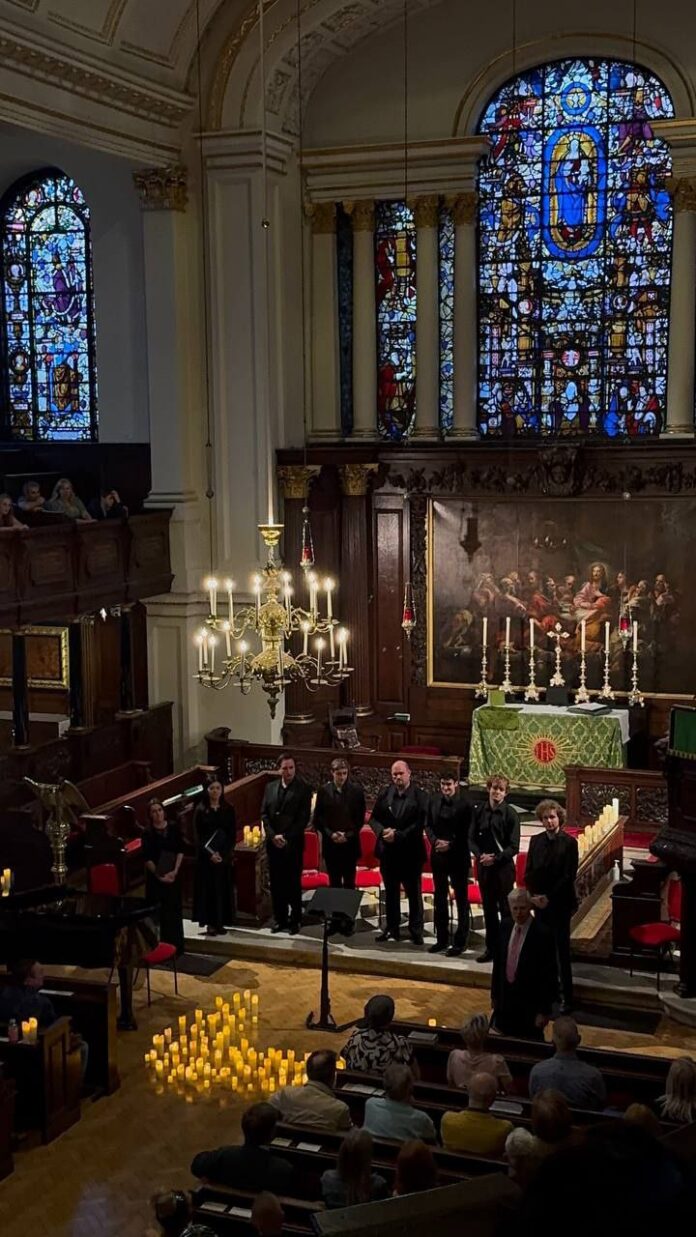
London – In the hushed, candlelit nave of a Mayfair church, Carl Orff’s Carmina Burana — that monumental ode to fortune, passion, and the flesh — was reimagined as something both intimate and incendiary. Under the assured and expressive direction of Ralph Allwood MBE DMus, this chamber performance drew its audience not into the spectacle of bombast, but into the heart of Orff’s elemental drama: the turning wheel of fate itself.
From the opening O Fortuna, delivered with taut precision by the Allwood Choir, the evening pulsed with a sense of ritual urgency. The eight-voice ensemble — drawn from some of Britain’s most distinguished vocal groups — filled the space with a sound that was at once expansive and immediate. Stripped of orchestral mass, this version revealed the intricate muscularity of Orff’s writing: every rhythmic strike, every harmonic collision, felt bare, vital, and alive.
The three-part structure — Spring’s Awakening, The Tavern, and The Court of Love — unfolded with the natural flow of a medieval morality play, each section deepening the emotional palette. Spring’s Awakening shimmered with renewal and innocence; The Tavern exploded with earthy exuberance and irony, its lusty rhythms and humour brought vividly to life by the male voices; and The Court of Love offered moments of luminous tenderness, with the two soloists (particularly the soprano) weaving passion and fragility into Orff’s ecstatic lines.
The live pipe organ and piano accompaniment were more than substitutes for a full orchestra — they became instruments of revelation. The organ’s sustained resonance gave the performance a sacred undertone, while the piano’s percussive clarity emphasised the raw theatricality at the core of the work.
What made this Carmina Burana exceptional, however, was its scale and setting. Surrounded by hundreds of flickering candles, the performance evoked not the grandiosity of a concert hall, but the primal intimacy of a ritual. The candlelight transformed the church into a living tableau — the singers’ faces illuminated as if by the very fire of fate Orff so famously invokes.
Allwood’s direction was as scholarly as it was visceral. Known for his decades-long contribution to British choral excellence — from Eton College to the Rodolfus Choir — he conducted with clarity and warmth, shaping dynamics that breathed and shimmered rather than overwhelmed.
At just over an hour, this London premiere felt both complete and concentrated, like a distillation of Orff’s cosmic vision into something human-sized and deeply felt. By the time the closing O Fortuna returned, the audience seemed caught in the same eternal cycle the work celebrates — the wheel turning, the candles flickering, fate once again triumphant.
This Carmina Burana by Candlelight was not merely a concert; it was an act of communion — between voice and space, past and present, passion and restraint. A rare and moving reminder that even in reduced form, Orff’s music can still ignite the senses and stir the soul.
Book your next concert visit: https://redevents.world/events/unitedkingdom?utm_source=ItalyNews&utm_medium=referral