


London – There is a rare kind of theatre that does not announce itself with spectacle but instead invites you into the stillness of a room, the quiet rhythms of two people who know each other almost too well. End, the final part of David Eldridge’s trilogy about modern love and the fragile architecture of human connection, is one of those productions. Set over a single early morning in June, the play unfolds with the naturalism and emotional clarity that have become Eldridge’s signature. The result is a work that is understated, tender, and quietly devastating.
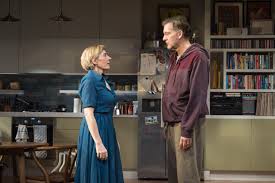
Clive Owen and Saskia Reeves give performances of remarkable intimacy as Alfie and Julie, a couple whose long life together has been shaped by music, laughter, and the inevitable strains of time. Watching them is like glimpsing a relationship through a half-open doorway — familiar, private, sometimes raw. Their chemistry is not loud or showy; it is textured, full of the kind of micro-shifts that come from decades of shared history. A glance that lasts a fraction too long, a silence that fills the room more than any argument could — these moments create the emotional topography of the play.
Owen, returning to the London stage, brings a quiet gravity to Alfie. His performance is grounded, controlled, and suffused with an understated melancholy. There is a heaviness to the way he moves through the domestic space, as though every object carries a memory. Reeves, meanwhile, offers an equally layered and deeply humane portrayal of Julie. She brings warmth, humour, and a kind of emotional luminosity that balances the darker undercurrents of the morning they are navigating. Together, they inhabit the stage with such lived-in truth that the play often feels less like theatre and more like eavesdropping on private life.
Rachel O’Riordan’s direction is exquisitely sensitive. She shapes the production with a steady hand, allowing the emotional beats to arise organically rather than forcing them. The pacing is deliberate, lean, and attentive to the subtleties of Eldridge’s writing. O’Riordan understands that this play lives in the small moments: a shared joke, a gesture of care, the slight tightening of the jaw before an impossible truth is spoken. She gives the actors the space to breathe, and the result is a production that feels precise yet deeply human.
The design further deepens this sense of authenticity. The domestic world created onstage is rich with detail — books, records, the familiar clutter of a home that has been lived in and loved for years. The space feels not only believable but emotionally charged, as though every shelf and lampshade carries its own story. The lighting by Sally Ferguson brilliantly captures the shifting atmosphere of early morning: the hesitant light creeping through windows, the sense of a day beginning while a life chapter may be ending. Donato Wharton’s sound design, subtle and unobtrusive, underscores the emotional current without drawing attention to itself.
What lingers most after the performance is the play’s emotional honesty. End is not a sweeping tragedy or a melodrama. Instead, it is a quiet reflection on the things we do not say, the ways we learn to love someone over time, and the moments when we realise that love itself may be asking us to change, or to let go, or to face truths we have softened for years. The humour is gentle, the heartbreak understated. The tenderness between Owen and Reeves gives the story a heartbeat that feels steady even as it trembles.
As a culmination of Eldridge’s trilogy, End feels both inevitable and deeply satisfying. If Beginning explored the spark of connection, and Middle examined the complications of building a life together, this final piece looks toward the moment when a couple must confront what remains — the beauty, the disappointment, the hope, the grief, and the profound courage of facing an ending with someone you love.
In the intimate confines of the Dorfman, the play resonates with a quiet force. It is a meditation on time, partnership, and the fragile tenderness that defines long-term relationships. End may be small in scale, but its emotional reach is vast. It leaves you with the sense that you have witnessed something deeply personal — a portrait of a relationship at its most vulnerable and its most human.
A beautifully acted, sensitively directed, and emotionally resonant piece of theatre.
https://www.nationaltheatre.org.uk/productions/end/