


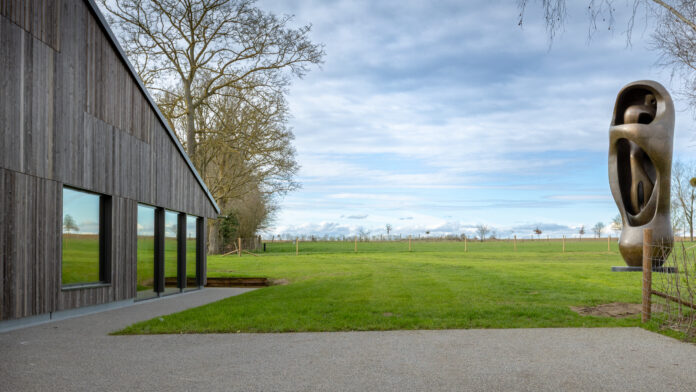
Hertfordshire – Each spring, the reopening of Henry Moore Studios & Gardens marks a return to one of Britain’s most distinctive cultural landscapes. Set in more than 70 acres of Hertfordshire countryside, the former home and workplace of Henry Moore offers visitors a rare opportunity to encounter sculpture, nature, and artistic process in direct dialogue.
In 2026, the season begins on Wednesday 1 April, and with it comes a significant development: the reopening of the newly redeveloped Sheep Field Barn, following a major architectural transformation.
A Landscape of Sculpture
Henry Moore Studios & Gardens is not a conventional museum. Across its open fields, Moore’s monumental sculptures are installed in the very landscape in which they were conceived and created. The works—often in bronze and on a large scale—sit among trees, grassland, and shifting light, inviting visitors to move around them and experience their changing forms.
The setting was integral to Moore’s practice. His sculptures, known for their organic shapes and exploration of the human figure, engage with space, horizon, and natural textures. Here, they are not isolated objects but part of a wider environment—one that reflects the artist’s lifelong engagement with nature and form.
The Artist’s Home and Studios
Visitors to the site can also explore Moore’s former home, Hoglands, along with a number of his working studios. These spaces provide insight into his daily practice, from initial sketches and models to the production of large-scale sculptures.
The estate also houses the Henry Moore Archive—one of the largest single-artist archives in the world—offering a deeper context for understanding his creative process and international influence.
The Redeveloped Sheep Field Barn
At the heart of the 2026 reopening is the Sheep Field Barn, which will reopen on 1 April 2026 following a major redevelopment.
Originally a farm building used by Moore and later adapted for gallery use, the barn has now been significantly transformed through an extension that doubles its footprint and reimagines it as a central space for exhibition and learning.
For the first time, the site will include a dedicated permanent exhibition on Moore’s life and career, tracing his development from the early 1920s to the final years of his work. Sculptures in wood, stone, plaster, and bronze will be shown alongside archival material—photographs, correspondence, and studio objects—bringing together the full scope of his artistic journey.
Alongside this, a programme of changing exhibitions will be presented in the upstairs gallery. The inaugural display will focus on Moore’s celebrated Shelter Drawings, created during the Second World War and depicting Londoners sheltering in the Underground during the Blitz. These works, both intimate and powerful, capture themes of vulnerability, endurance, and shared humanity.
Learning, Making, and Engagement
A key feature of the redevelopment is the introduction of purpose-built learning studios, placing creative practice at the centre of the visitor experience. These spaces will host workshops, talks, family activities, and community programmes, encouraging visitors not only to view art but to engage with it through making and experimentation.
With direct access to the surrounding landscape, the studios echo Moore’s own approach—working in close dialogue with the environment and materials at hand.
Visiting Information
The 2026 season will run from:
1 April to 1 November 2026
Open Wednesday to Sunday and Bank Holidays, 11:00–17:00
A single ticket provides access to the gardens, exhibitions, studios, and archive displays, offering a comprehensive experience of Moore’s life and work.
A Living Artistic Legacy
More than a museum, Henry Moore Studios & Gardens remains a living site of artistic legacy—where sculpture, landscape, and history converge. The reopening of the redeveloped Sheep Field Barn in April 2026 strengthens this vision, creating new ways for visitors to encounter one of Britain’s most influential artists in the place that shaped his work.https://henry-moore.org/studios-and-gardens/