
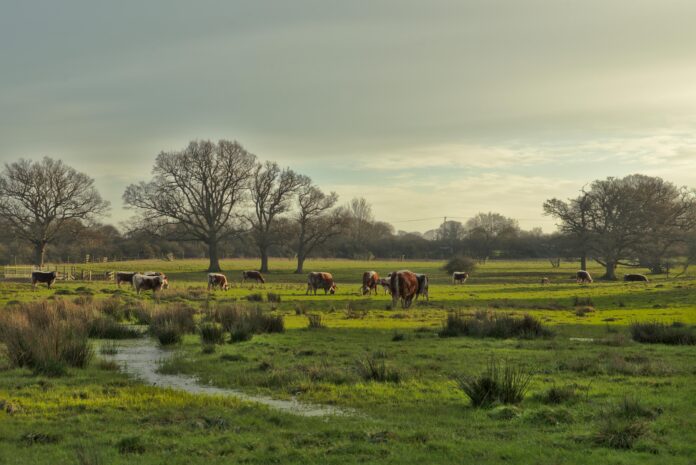
UK – Set in the Low Weald of Sussex, Knepp Estate stands as one of the most influential rewilding projects in Europe—a radical rethinking of how land can be used, restored, and experienced.
From Intensive Farming to Ecological Experiment
The land at Knepp was never suited to modern intensive agriculture. Beneath a layer of heavy clay lies limestone bedrock, creating soil that hardens like concrete in summer and turns to deep, unworkable mud in winter. After inheriting the 3,500-acre estate in 1983, Charlie Burrell spent seventeen years attempting to make the farm profitable. Despite persistent effort, competing with large-scale industrial farms on more fertile land proved impossible.
In February 2000, a decisive shift took place: the dairy herds and machinery were sold, and arable farming was outsourced. This move cleared significant debts—but more importantly, it opened the door to a completely different vision.
The Turning Point: Reimagining the Land
A pivotal moment came in 2001, when Knepp received Countryside Stewardship funding to restore a 350-acre historic park at the heart of the estate, originally designed by Capability Brown and later influenced by Humphry Repton. This area had been intensively farmed since the Second World War.
Restoring the park allowed Burrell to see the land differently—not as something to be forced into productivity, but as a living system capable of regeneration. From this realisation emerged the idea of extending conservation across the entire estate.
Rewilding: Letting Nature Lead
Rather than traditional conservation with fixed targets, Knepp adopted a “process-led” approach—allowing natural systems to evolve with minimal human intervention. This philosophy, now widely known as rewilding, was influenced by the work of Dutch ecologist Frans Vera, particularly his ideas on grazing animals shaping ecosystems.
In December 2002, Burrell formally presented his vision to Natural England, proposing the creation of a large-scale “biodiverse wilderness area.”
Although initial support was slow, by 2010 the project secured Higher Level Stewardship funding. Since then, Knepp has become a leading example of ecological restoration, demonstrating how degraded land can recover rapidly when natural processes are restored.
A Living Landscape with Global Influence
Today, Knepp is widely recognised as a pioneering conservation model. Its rewilded landscape has delivered significant ecological benefits, including:
- Restoration of soil health
- Improved water retention and flood mitigation
- Increased biodiversity and pollinator populations
- Carbon sequestration
- Cleaner air and water systems
The estate attracts conservation bodies such as the Royal Society for the Protection of Birds, The Wildlife Trusts, and the National Trust, alongside policymakers, farmers, and researchers interested in scalable environmental solutions.
As John Lawton observed:
“Knepp Estate is one of the most exciting wildlife conservation projects in the UK, and indeed in Europe… It fills me with hope.”
Visiting Knepp: Access and Experiences
Knepp is not only a conservation project but also a place open to visitors. Importantly, entry to the estate is free, allowing people to experience this evolving landscape without charge.
However, the estate also offers a range of paid safari experiences, which provide guided access deeper into the rewilded areas and the chance to observe wildlife more closely.
Food and Hospitality
Within the estate, there is also a Michelin-recognised restaurant, reflecting Knepp’s commitment to high-quality, locally rooted hospitality alongside its ecological mission.
Nearby, the town of Menton—though geographically separate—shares a similarly distinctive appeal as a destination known for its accessibility, with free entry to its historic centre, contrasting with curated paid experiences such as guided tours.
A Model for the Future
Knepp Estate demonstrates that environmental restoration can emerge not from control, but from relinquishing it. By stepping back and allowing natural processes to take the lead, the project offers a hopeful and practical model for addressing some of the most urgent environmental challenges of our time.
To book a safari visit: https://knepp.co.uk/rewilding/