


London – The London Design Festival will return from 12 to 20 September 2026, bringing nine days of installations, exhibitions and design events across the capital, with organisers promising an edition centred on global dialogue, cultural exchange and innovation.
Unveiled during a preview event held on 1 July at Isla Terrace at The Standard, London, the 24th edition of the festival will once again transform London into a city-wide celebration of design, featuring Landmark Installations, Special Projects, the Global Design Forum, the London Design Medals, design fairs and a Partner Programme spread across eleven Design Districts.
Recognised as one of the UK’s leading design events and a fixture of the international cultural calendar, the festival continues its commitment to supporting both emerging and established designers while encouraging collaboration across the global design community.
According to the organisers, this year’s programme is shaped by the convergence of craft traditions, international collaboration and future-facing technologies. Many of the projects explore how cultural heritage, material innovation and digital thinking can coexist, creating conversations that bridge East and West, past and future, and the physical and digital worlds.
Sustainability and circular design also emerge as recurring themes throughout the programme, positioning London not only as a showcase for creative excellence but also as a platform for wider discussions about the future of design.
For 2026, the Mayor of London has been announced as the Festival’s Principal Supporter. The event also continues to receive support from Bloomberg Philanthropies, while Bloomberg Connects will once again serve as the Festival’s official digital guide, offering visitors exclusive commentary, video content and curated routes throughout the city.
“London Design Festival 2026 is proving to be an exceptional year with a vibrant array of international installations and projects, new design districts, and an expanding Global Design Forum following the success of Global Design Forum Istanbul in May,” said Ben Evans CBE, Director and Co-Founder of the London Design Festival.
“London retains its allure as a global design capital engaging with expanding audiences, partners across the economy, and a high profile made by the layers of design stories that the Festival is home to.”
The festival programme will feature installations across some of London’s best-known cultural destinations, including the Barbican, the Victoria and Albert Museum (V&A), the Strand, Somerset House and Wapping, where internationally acclaimed designers will present ambitious public works intended to inspire debate and connect audiences with contemporary design.
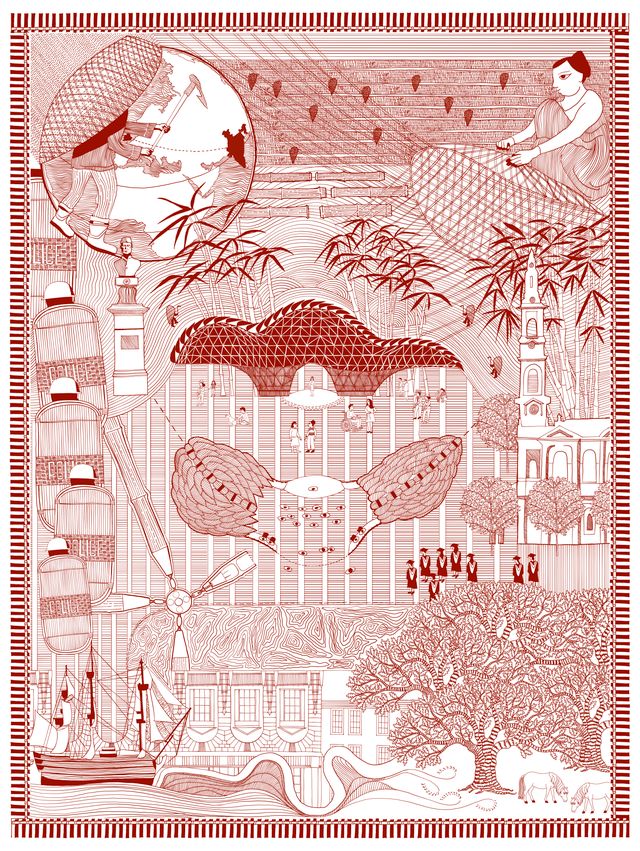
Among the first major commissions announced for this year’s festival is The Pangolin Shield, a new Landmark Project by Studio Saar in collaboration with structural engineers Atelier One, supported by Secure.
Installed on the Strand, the pavilion explores themes including colonial legacies, ecological exploitation, migration and the movement of people and species across borders. Inspired by the pangolin—the world’s most trafficked mammal—the installation reflects the animal’s protective scales while examining ideas of vulnerability, protection, displacement and acceptance.
The pavilion combines a bamboo gridshell structure with traditional Indian police shields made from lathis and woven rain shields known as knups, traditionally used by farmers in north-eastern India. Arranged like overlapping scales, the shields create a protective canopy that filters light while providing shelter for visitors.
By removing police shields from their original context and combining them with agricultural rain shields, the installation seeks to transform symbols associated with confrontation into a space intended to encourage rest, dialogue, empathy and community.
Positioned on the pedestrianised Strand, the pavilion faces the bust of Jawaharlal Nehru, India’s first Prime Minister, located outside the Indian High Commission. According to the organisers, this spatial relationship is intended to encourage reflection on colonial history, power, ecological exploitation and cross-border movement.
The project also highlights Studio Saar’s cross-cultural practice. Founded by Ananya Singhal, the studio works across the UK and India, bringing together architects, makers, researchers and communicators.
The pavilion has been engineered in partnership with Atelier One, led by founder and director Neil Thomas MBE, a practice recognised internationally for advancing bamboo as a low-carbon structural material.
As London prepares to welcome designers, makers and visitors from around the world this September, the 2026 edition aims to reaffirm the city’s role as an international meeting point where design becomes a catalyst for cultural exchange, innovation and global conversation.