

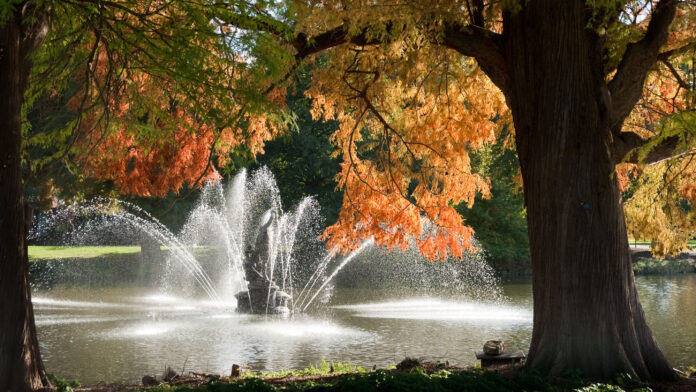
London – The morning light at Kew Gardens in autumn feels almost ceremonial — a kind of quiet procession through gold and rust. As I walked beneath the vaulted glass of the Palm House, where condensation clung to Victorian ironwork and rare leaves unfurled like soft archives of the Earth’s memory, I was reminded that Kew is not just a garden but a living museum of empire. Every palm, spice, and bloom has a story to tell — and this season, those stories have found their voice.
At the Shirley Sherwood Gallery of Botanical Art, two extraordinary exhibitions — The Singh Twins: Botanical Tales and Seeds of Empire and Flora Indica: Recovering the Lost Histories of Indian Botanical Art — invite visitors to look beyond beauty and into history. Running from 11 October 2025 to 12 April 2026, these parallel displays illuminate both the artistic splendour and the colonial entanglements that shaped Kew’s collections.
Seeds of Empire — Art as Reclamation
In Gallery 5, The Singh Twins — internationally acclaimed contemporary British artists and sisters Amrit and Rabindra Kaur Singh — unfold a dazzling tapestry of history, myth, and critique. Their works, rich in symbolism and saturated colour, fuse the visual language of Indian miniature painting with digital technologies and Western iconography.
Through pieces such as Seeds of Empire: The Age of Discovery and The Masala Art Series, they reveal how the global trade in plants — cotton, saffron, poppies, pomegranate — became both a source of wonder and exploitation. These works expose how the British Empire’s pursuit of botanical wealth was inseparable from conflict, enslavement, and commerce.
A highlight of the exhibition is the short film King Cotton: An Artist’s Tale, a poetic meditation on the colonial legacy of the cotton trade and its contemporary echoes in globalisation and climate change. Yet for all their historical gravity, The Singh Twins’ artworks radiate vitality — a celebration of cross-cultural resilience and a reclamation of narrative.
As they themselves write, their collaboration with Kew has been “fascinating and illuminating,” offering a space where the colonial past can be confronted without losing sight of the deep-rooted spiritual and cultural meanings that plants hold across global traditions.
Flora Indica — The Hidden Hands Behind the Beauty
Stepping into Flora Indica (Galleries 1–4), curated by Dr Henry Noltie and Dr Sita Reddy, feels like entering a rediscovered archive — a meeting place of art, science, and forgotten lives. Here, 52 exquisite botanical paintings, created between 1790 and 1850 by Indian artists working for the East India Company, are unveiled for the first time.
These delicate watercolours — depicting poppies, cotton, and tropical flora — were once classified as anonymous colonial documents. Today, thanks to meticulous research, they are finally attributed to their rightful creators: Indian artists whose precision and artistry helped shape the scientific understanding of the world’s plants.
Each brushstroke tells a layered story — of artistry under imperial commission, of cultural exchange and erasure, and of the scientific hunger that drove Britain’s global ambitions. The exhibition contextualises these paintings alongside herbarium specimens and archival objects, bridging the aesthetic and the historical with quiet reverence.
A Living Dialogue
What makes these two exhibitions so powerful is their dialogue across time. Flora Indica reclaims the past — giving names and faces to those who painted the Empire’s flora into permanence — while The Singh Twins reinterpret that past through contemporary eyes, connecting the imperial trade in plants to modern-day issues of inequality, ecology, and belonging.
This curatorial pairing transforms Kew into a space of conversation rather than commemoration — one where art and botany speak together about the intertwined destinies of nature and empire.
The Taste of India at Kew
After wandering through the galleries, I stopped at Kew’s Pavilion Bar & Grill, where acclaimed chef Anjula Devi has curated a special Indian-inspired menu (11 October – 14 November). Her dishes, fragrant with cumin, saffron, and coriander, extend the exhibitions’ themes from canvas to cuisine — a sensory dialogue between heritage, spice, and storytelling. Devi’s approach to food mirrors The Singh Twins’ approach to art: reclaiming tradition as an act of empowerment.
Reflections in the Garden
As I left the gallery and stepped back into the cool amber light, the air was thick with the scent of autumn leaves and distant roses. The day felt like an offering — not just to beauty, but to understanding.
Kew’s new exhibitions remind us that every plant carries a human history, every flower an untold story. The botanical drawings of colonial India and the luminous digital tapestries of The Singh Twins together reveal that the garden — like the empire that once cultivated it — is both archive and mirror.
And as I walked beneath the whispering plane trees, it seemed clear that Kew’s strength lies not only in preserving the natural world, but in daring to confront the past that shaped it.
<a href="http://https://www.kew.org/“>https://www.kew.org/