


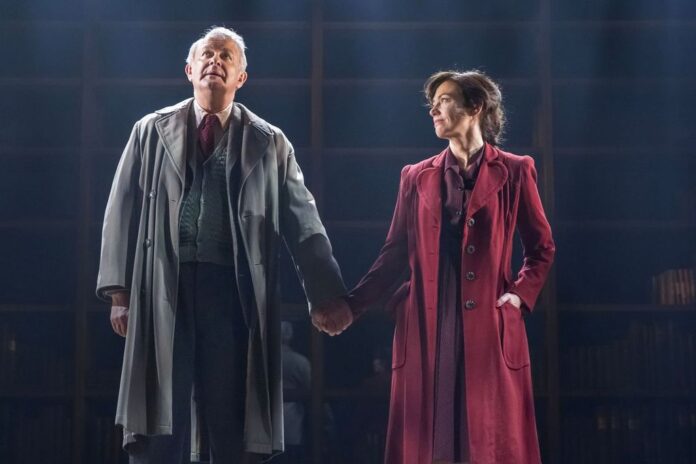
London – There is something quietly devastating about Shadowlands. It does not announce itself with spectacle or theatrical bravado. Instead, it unfolds with emotional precision, tracing the unexpected love between C.S. Lewis and Joy Davidman — a relationship that gently but irrevocably unsettles certainty, faith and the tidy architecture of an academic life.
Starring Hugh Bonneville as C.S. Lewis and Maggie Siff as Joy Davidman, this strictly limited engagement brings to the West End a story that feels both intimate and immense. Bonneville embodies the celebrated author of The Chronicles of Narnia — a man known for intellectual clarity and theological conviction — while Siff plays the spirited, fiercely intelligent American poet who challenges and transforms him. Their dynamic is rooted in argument and admiration: two formidable minds circling one another before daring to acknowledge something deeper.
Written by William Nicholson and directed by Rachel Kavanaugh, Shadowlands carries with it a formidable theatrical legacy. Originally a BAFTA Award-winning television film, it became a West End success, won the Evening Standard Award for Best Play, transferred triumphantly to Broadway where it received a Tony Award, and was later adapted into the 1993 feature film directed by Richard Attenborough and starring Anthony Hopkins and Debra Winger. Knowing this history lends the current production a sense of lineage — a story that continues to resonate across generations because it speaks to something elemental.
What moved me most about this production is the simplicity of its emotional premise. What begins as an intellectual correspondence becomes a meeting of equals — sharp minds sparring, questioning, probing. But beneath the wit and argument lies something more fragile. Joy’s presence disrupts Lewis’s ordered world; love enters not as comfort, but as risk. The play reminds us that love does not shield us from suffering — it deepens it — and yet it is precisely that vulnerability which makes life luminous.
There is also a quiet meditation here on grief. Lewis, so often remembered as the confident Christian apologist, is shown confronting a loss that dismantles his carefully constructed certainties. The play does not offer easy answers. Instead, it allows space for doubt, for anger, for the bewildering coexistence of faith and despair. In this way, the journey feels profoundly human. Joy and grief sit side by side, inseparable.
The production arrives at the Aldwych following its sell-out run at Chichester Festival Theatre, and it feels entirely at home in this historic West End venue. There is something fitting about watching a story concerned with faith, doubt and love in a theatre steeped in its own rich dramatic history. The setting enhances the sense that we are witnessing not just a romance, but a chapter in cultural memory.
Ultimately, Shadowlands is not simply about C.S. Lewis the public figure, nor Joy Davidman as muse. It is about the human cost of loving fully. It asks what happens when certainty collapses — and whether faith can survive heartbreak. In an age that often prefers irony to sincerity, this play dares to be earnest. And that, perhaps, is its quiet power.
It is a story of minds meeting — and hearts breaking — told with dignity and emotional truth. The production runs at the Aldwych Theatre until 9 May 2026, with its final performance scheduled for that date.