


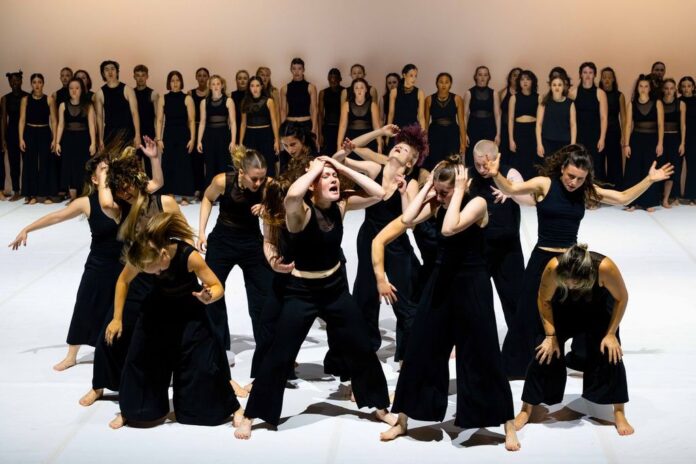
London – There are moments in COLOSSUS when it becomes almost impossible to distinguish where one dancer ends and another begins. Bodies ripple across the stage like currents of water, before coalescing into an immense, breathing organism that appears to possess a consciousness of its own. It is an extraordinary visual achievement and a remarkable UK debut for Australian choreographer Stephanie Lake.
Presented as part of the Southbank Centre’s 75th anniversary celebrations, COLOSSUS arrives in London after seventeen seasons across nine countries, yet feels uncannily timely. Performed by fifty final-year students from London Contemporary Dance School at The Place, the work explores the perpetual tension between individuality and collective identity—a theme that resonates powerfully in an era increasingly defined by political polarisation, social conformity and mass movements.
Running for just under an hour without interval, the production wastes no time establishing its hypnotic vocabulary. Emerging slowly from darkness, the ensemble forms a dense human mass that continually mutates through waves of movement. A raised arm, a sudden turn of the head or a subtle shift in weight reverberates across the stage like a domino effect, creating intricate chain reactions that transform apparent chaos into astonishing moments of order.
Lake’s choreography is remarkable for its mathematical precision while never feeling mechanical. Instead, every sequence retains an organic unpredictability, as though the dancers are responding instinctively to an invisible force rather than executing rehearsed patterns. The work constantly oscillates between unity and fragmentation: individuals briefly emerge from the crowd before being reabsorbed into its gravitational pull, questioning whether personal identity can truly exist outside the collective.
The scale of the production is its most immediately striking feature. Fifty performers occupy the Queen Elizabeth Hall stage with astonishing spatial intelligence, creating images that range from turbulent swarms to architectural formations. Yet despite the sheer numbers, the choreography avoids spectacle for spectacle’s sake. Every movement serves a larger emotional and philosophical purpose.
Equally impressive is the commitment of the young cast. The students from London Contemporary Dance School perform with remarkable discipline and stamina, maintaining extraordinary synchronicity while negotiating relentlessly demanding physical material. Their collective precision is all the more impressive given that COLOSSUS relies not on uniformity but on countless subtle variations within the ensemble. It is difficult to imagine a more fitting culmination of three years of professional training.
One of the production’s greatest strengths lies in its refusal to impose a single narrative. The crowd can evoke many things simultaneously: migration, protest, celebration, ecosystems, urban life or even the microscopic behaviour of living cells. Different audience members will inevitably project their own interpretations onto the constantly shifting formations, making each viewing a deeply personal experience.
Visually, the production embraces elegant minimalism. Without elaborate scenery or theatrical distractions, attention remains fixed on the extraordinary possibilities of the human body. The constantly evolving formations become the set design themselves, demonstrating how contemporary dance can create immense theatrical impact through movement alone.
The accompanying score intensifies the sense of mounting tension and release, propelling the ensemble through cycles of accumulation and dissolution. Sound and movement become inseparable, amplifying the work’s almost trance-like atmosphere until the audience appears collectively mesmerised.
If there is a minor criticism, it is that the conceptual framework occasionally risks repetition during the middle section, where similar motifs recur before the work regains momentum towards its exhilarating conclusion. Yet even these quieter passages allow viewers to appreciate the astonishing intricacy of Lake’s choreographic architecture.
More than simply a showcase of physical virtuosity, COLOSSUS poses profound questions about contemporary society. How much individuality do we surrender in order to belong? Can order emerge naturally from apparent disorder? Are we strengthened or diminished by becoming part of something larger than ourselves? These questions linger long after the final image fades into darkness.
Stephanie Lake has built an international reputation as one of Australia’s most innovative choreographic voices, and COLOSSUS demonstrates exactly why. The work combines intellectual ambition with visceral theatricality, offering an experience that is simultaneously spectacular, unsettling and deeply moving.
At a time when dance increasingly explores technology and multimedia, COLOSSUS reminds us that the human body remains theatre’s most powerful instrument. Fifty dancers become a single pulse, a single breath, a single force—and in doing so create one of the most compelling contemporary dance experiences to reach London this year.
https://www.southbankcentre.co.uk/