


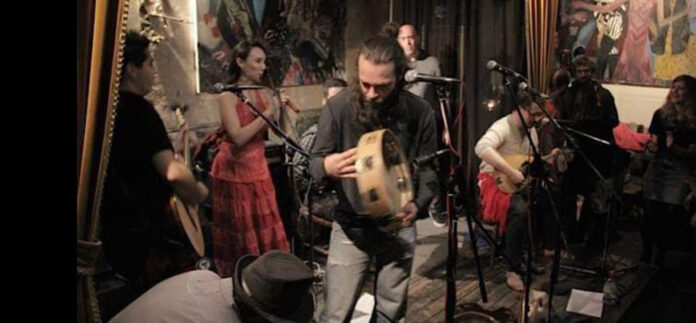
London – On the 29th at Brixton Jamm, London will once again be swept by the rhythms of Salento as Amaraterra, the city’s long-standing ambassadors of the traditional southern Italian dance music pizzica, return to the stage. Over nearly fifteen years, the group has built a devoted fan base, becoming one of London’s most vibrant live musical fixtures—equal parts irresistible dance party, cultural preservation project, and communal celebration.
London Roots, Salento Spirit
Amaraterra began in 2011, formed by a group of musicians from the Salento peninsula who had settled in London and shared a passion for their regional traditions. Pulling their early audiences from Italian community gatherings and restaurants—especially La Pizzica in Fulham, where they still perform every year on 11 November for San Martino—the group gradually expanded into a multicultural collective. Over time, they absorbed not only wider southern Italian folk influences but also the raw energy of London’s grassroots music scene.
Today, Amaraterra’s core line-up includes Alfredo Giani, Federico Tommasi, Cassandre Balbar, Massimiliano Passante, Antonio Fersini, and the sole English member, Mark Glanville, who speaks here on behalf of the group.
The band has become a regular presence at some of London’s best small venues, including Jam in a Jar, the Jamboree, the Magic Garden, the Jago, and Brixton Jamm. Their reach extends beyond the city, too: in 2016, they were invited to perform at WOMAD, fresh off the success of their debut EP Tradizioni. In 2021, they released their first full-length album, Malvasia—a collection that blends original compositions with faithful interpretations of pizzica’s traditional repertoire.
The Fans Who Became Organisers
Not all of Amaraterra’s story has been written from the stage. The band’s presence on the Cycling Podcast, where their music has accompanied Giro d’Italia coverage for over a decade, first introduced many listeners to their work. Some of them—Henry and a group of London fans—began organising shows with Amaraterra after the pandemic, motivated by one simple fact: they missed the music.
The collaboration now leads to multiple concerts every year, some of which have become the group’s most successful headline events. The 29th continues that story.
Q&A with Amaraterra
Responses by Alfredo Giani, founder of Amaraterra group.
How was Amaraterra formed, and what brought the members together?
Amaraterra was formed around 2011, when a group of Salentini living in London decided to form a pizzica band within the context of the association “Friends of Puglia”. We started playing at social gatherings and Italian restaurants most noticeably, La Pizzica restaurant in Fulham, owned by one of our greatest fans and early supporters, Gianluca D’Aversa.
To this day, almost 15 years down the line, we still play at La Pizzica every 11th of November for San Martino.
What brought us together was the desire to bring a piece of the homeland with our music and most importantly our dance. It was a challenge to propose something like that to the general public in London: crossing the barriers of an unusual music style and instrument (the tamburello, frame drum) and lyrics in a language, either Salentino or Griko, that even in Italy is barely understood outside the region!
What does the name Amaraterra represent for the group’s identity and mission?
The name Amaraterra was born at the very beginning of our adventure as a tribute to the song “Amara terra mia” by the Apulian Domenico Modugno in the 50’s. A song that talks about immigration and the pain associated with it. Although as modern emigrants we are very distant from the harsh conditions during the great emigration wave – some would say we are “expats”, but I personally find this definition a bit snobbish – we felt we wanted to pay tribute to the millions of young Italians that, like us, left the Country in search of a better future.
Then, it just got stuck! And it is great for lettering and logo – the red and white theme on the name has been a fixture of all our merchandising since then.
How do you balance respect for Salento’s musical traditions with your own artistic innovations?
We don’t innovate much, for a start. Although as individual musicians we are quite eclectic and we listen – and practice! – all sort of musical styles, we are very concerned about not diluting the musical canon into any form of fusion.
Where we have innovated, in our view, is in the way we approach the live show. Pizzica is traditionally played in open squares, but being based in London, we adapted our performances to the small-medium gig vibe that is typical of the city.
We thrive on low stages, close contact with the public, and the search for that “rowdy” party that we and our audience enjoy – a tribute perhaps to the city and the country that gave punk to the world!
The best compliment we ever had? A quote from FRoots magazine about our first album: “If it was Irish folk music, they would be like The Pogues.”
For someone who has never heard it, how would you explain what la pizzica is and why it matters today?
The short answer is that pizzica is the regional folk dance and music from a beautiful part of Italy at the crossroads of the Mediterranean. The best answer is to get a drink, relax, let us start to play, and let the music – and the party – explain more than a thousand words.
The long story is that pizzica is an anthropologic “living fossil” with roots that may go back to the Bronze Age, once diffused all over the Mediterranean. But for that, there are books enough to fill a big shelf!
Which elements of pizzica are most central to your performances?
The public, their energy, and how they react to the surge in intensity which is, the way we see it, the central element of pizzica.
What emotions or states of mind do you hope to evoke through your interpretation of pizzica?
A central aspect of pizzica is the ritual of the tarantate, the traditional healing dance of Salento, practiced by women and linked to the mythic bite of the tarantula. In modern times this has been syncretised within the Catholic veneration of St. Paul.
The goal was ecstatic trance. In London today, we want to transmit a feeling of carefree, communal happiness. And in a city like London, there is always a need for that!
We’re proud to have played at so many weddings and to be part of the cherished memories of people who have lived here since 2011.
Can you describe a recent moment on stage that felt especially meaningful?
Being invited twice to play on a main stage at WOMAD has certainly been a sign that somehow, “we made it”. But honestly, our gigs in London’s usual venues are just as loved because, after 15 years, they are a gathering of old friends: Amaraterra and the public.
What is the future of pizzica?
We do not see a particular future of pizzica within contemporary music – it will be a surprise! From Stewart Copeland to Ludovico Einaudi, many have experimented with it. Whoever comes next will decide; we are sure it will be interesting.
For popular culture, we expect the future to be like the present and the past: full of happiness.
The music is a conduit to a goal – dance and be merry! We barely change our playlist and people still have the time of their life. Why change?
1What are your next creative goals?
Our main goal is to keep doing what we do. Most of us are musicanti (semi-professional musicians) with “regular” jobs. This connects us to how traditional music was played in the rural South – farmers and shopkeepers playing after work.
Our dream is to release a live album, capturing the raw energy of our shows, as a complement to our curated studio album Malvasia.
Personal dream? A movie or documentary score. We once adapted our music for a documentary in 2016, and arranging for the spoken word was something I would love to explore further.
To book your ticket for the 29th of November, visit: https://www.brixtonjamm.org/whatson/amaraterra291125