


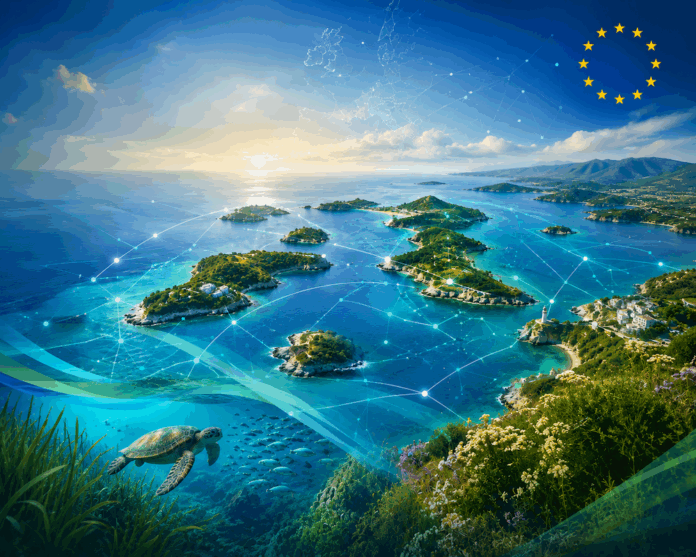
City of London – The European Commission’s presentation of the first EU strategies dedicated to islands and coastal communities marks a significant shift that extends well beyond the traditional framework of territorial cohesion policy. It is not simply about reducing economic disparities between central and peripheral regions; rather, it represents an acknowledgement that these territories constitute structural stress points within the European Union, where economic, social, environmental and health-related vulnerabilities converge and become particularly pronounced.
From this perspective, islands should no longer be viewed as marginal peripheries but as laboratories for testing the systemic resilience of contemporary Europe.
The Commission’s new strategic approach signals a fundamental change in perspective. Islands and many coastal communities are no longer regarded merely as disadvantaged territories requiring compensatory measures. Instead, they are increasingly recognised as strategic nodes in the European Union’s geopolitical and maritime projection.
Their strategic importance operates across several interconnected dimensions:
- safeguarding maritime routes and critical infrastructure;
- managing the European Union’s internal and external borders;
- advancing the blue economy and the offshore energy transition;
- ensuring environmental stewardship and territorial governance across Europe’s maritime domains.
Within this framework, geographical remoteness is effectively redefined: what has traditionally been perceived as peripheral emerges instead as central to the geopolitical resilience of the European Union.
Social Fragility and Demographic Instability
From a social perspective, islands and many coastal regions share a number of recurring structural challenges, including depopulation, ageing resident populations and a high degree of dependence on seasonal tourism.
These dynamics generate inherently unstable social systems characterised by:
- significant reductions in the availability of public services during the low season;
- substantial pressure on infrastructure during peak tourist periods;
- persistent difficulties in attracting and retaining qualified professionals;
- an increasing divide between permanent residents and temporary populations.
The result is a condition of “dual territorial temporality”, in which long-term planning is continuously shaped—and often constrained—by profound seasonal fluctuations.
🏝️Islands as Stress Tests for 🏥Healthcare Systems
The healthcare sector perhaps illustrates most clearly the systemic nature of these vulnerabilities. In this context, one observation captures the essence of the issue:
If a healthcare system works effectively on a small island, it is likely to work in a large city. The opposite, however, cannot be assumed.
This statement reflects a fundamental distinction between systems characterised by high vulnerability and limited redundancy, and those benefiting from greater organisational density and compensatory capacity.
A small island typically presents conditions in which:
- healthcare personnel are limited;
- diagnostic and hospital capacity is constrained;
- logistics—including transport, weather conditions and emergency response—become critical clinical determinants;
- healthcare demand is highly seasonal and subject to significant fluctuations.
Under such circumstances, inefficiencies cannot be absorbed by the system; they rapidly become operational failures.
Conversely, large metropolitan healthcare systems may continue to appear effective despite underlying structural weaknesses, largely because organisational redundancy and scale compensate for operational shortcomings.
From this perspective, islands should not be regarded as peripheral healthcare settings but as genuine stress tests for the governance capacity of European health systems.
A One Health Perspective: Island Ecosystems, Human Health and Biodiversity as an Integrated System
The One Health paradigm assumes particular significance in islands and coastal communities, where the separation between human health, environmental integrity and social dynamics becomes increasingly artificial.
This interdependence is further reinforced by a distinctive characteristic shared by many European islands: the widespread presence of national parks, regional parks and protected terrestrial and marine areas. Many islands host ecosystems of exceptional ecological value, often incorporated into the EU Biodiversity Strategy, the Natura 2000 network and the broader objectives of the European Green Deal.
Consequently, islands should be understood not merely as inhabited territories or tourist destinations, but as European ecological infrastructures, where ecosystem integrity is directly linked to the health and well-being of resident communities.
This creates an intrinsic overlap between several policy domains:
- biodiversity conservation and the management of protected areas, including the Natura 2000 network;
- territorial healthcare policy and disease prevention;
- the blue economy and the sustainable use of marine resources;
- the management of tourism flows and seasonal anthropogenic pressure.
Within this integrated framework, human health and ecosystem health cannot be treated as separate policy areas. Water quality, waste management, coastal erosion, biodiversity loss and climate change all exert direct and measurable effects on population health.
Islands therefore emerge as spaces where health, environmental and climate policies converge, making the One Health approach not simply a theoretical framework but an operational necessity for effective governance.
Governance and the Limits of the Current European Approach
The European Commission’s new strategies ultimately raise a broader governance question: can the European Union develop effective policies for territories that are structurally heterogeneous rather than uniform?
Islands and coastal communities require flexible and integrated governance models capable of coordinating:
- territorial healthcare planning;
- climate adaptation;
- management of critical infrastructure;
- demographic and social policies;
- environmental protection and biodiversity conservation.
The challenge extends well beyond the allocation of financial resources. It concerns the development of a genuinely systemic approach to Europe’s territorial complexity.
Conclusion: From Peripheral Territories to Europe’s Systemic Truth Points
The new European strategies for islands and coastal communities may be interpreted as an initial attempt to acknowledge that territorial cohesion alone is no longer sufficient as the primary framework for understanding Europe’s territorial challenges.
Rather than exceptional territories requiring special treatment, islands represent systemic truth points for the European project: places where structural vulnerabilities emerge most clearly and where the Union’s capacity for resilience can be assessed in its most tangible form.
In this sense, islands are not Europe’s margins. They constitute its most demanding systemic stress test—a space where geopolitics, society, environmental sustainability and public health converge into a single arena for evaluating the future resilience of the European Union.
Riccardo Cacelli
r.cacelli@uam-vertiports.com