


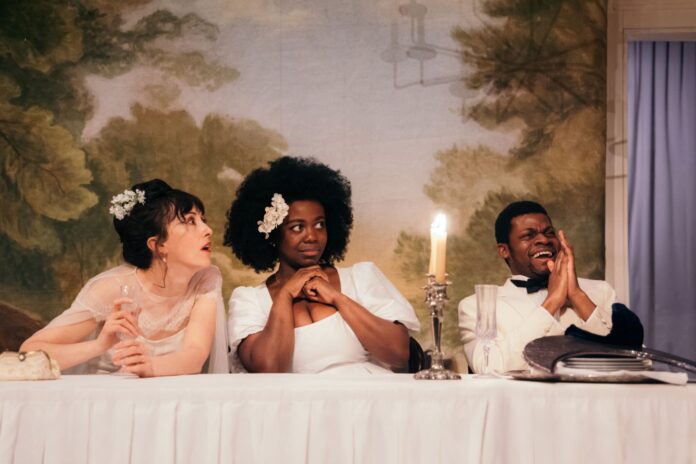
London – There is something quietly radical about staging A Midsummer Night’s Dream by candlelight. In the intimate wooden womb of the Sam Wanamaker Playhouse, Shakespeare’s most familiar comedy is stripped of its pastoral prettiness and reimagined as something darker, stranger, and more unsettlingly contemporary.
This new co-production between Shakespeare’s Globe and Headlong, directed by Holly Race Roughan and co-directed by Naeem Hayat, leans decisively into the play’s sense of instability. Here, the forest is not a space of benign magic but a volatile, shadowy underworld where desire, power, and identity are dangerously fluid. As Roughan suggests, this is a world “upside down and unpredictable” — one that resonates strongly with our present moment.
The choice of the Sam Wanamaker Playhouse proves inspired. Candlelight does more than illuminate the stage: it creates a flickering moral landscape where illusion and reality blur, and where even comedy feels edged with menace. When night falls in this Dream, it feels genuinely nocturnal; when snow falls in summer, it is not whimsical but quietly apocalyptic.
The cast navigates this tonal complexity with assurance. Hedydd Dylan brings a commanding duality to Hippolyta and Titania, embodying both regal restraint and feral authority, while Michael Marcus’s Theseus/Oberon exudes a brittle, political masculinity that underscores the play’s uneasy power dynamics. As Puck, Sergo Vares resists the temptation of light-hearted mischief, offering instead a mercurial presence that feels knowingly dangerous.
Among the lovers, Tiwa Lade’s Hermia and Tara Tijani’s Helena ground the chaos in emotional clarity, allowing the comedy of confusion to emerge without undermining the pain and humiliation embedded in their situations. Danny Kirrane, as Bottom, delivers a performance that balances physical comedy with a surprising tenderness, reminding us that transformation — even comic transformation — carries risk.
Visually, Max Johns’ design works in concert with Joshie Harriette’s candlelight and lighting to create a mutable, breathing space rather than a fixed setting. Shadows stretch, faces emerge and disappear, and the play’s action feels perpetually on the verge of slipping out of control. Nicola T Chang’s sound and composition deepen the sense of unease, while movement director Malik Nashad Sharpe ensures that bodies, not just words, tell the story of disorientation and desire.
This is not a Dream designed to reassure. Instead, it asks us to re-examine what we think we know about Shakespeare’s comedy — its treatment of consent, its politics of love, its uneasy laughter. In doing so, the production honours the play’s enduring relevance rather than embalming it in charm.
By the time the candles gutter and the night begins to lift, this Midsummer Night’s Dream feels less like an escape and more like a mirror: darkly reflective, unsettling, and deeply of its time. It is a bold, intelligent reimagining that proves how much danger — and how much truth — still lurks in Shakespeare’s most-loved comedy.