
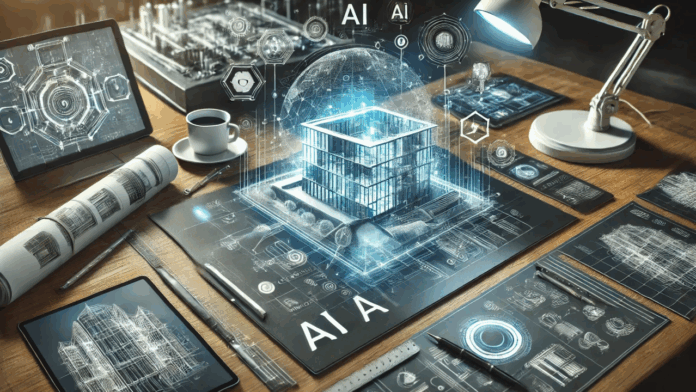
Architecture is repeatedly told to be afraid.
Afraid of new tools ⚒️.
Afraid of emerging technologies 💻.
Afraid of becoming obsolete ⏳.
Today, that fear has a name: Artificial Intelligence 🤖
Me? I’m not afraid.
AI is not the enemy of architecture.
It’s not here to replace us.
It’s simply the latest tool in a long evolution that has changed the way we think, draw, and imagine space 🌐.
Let’s break it down 👇
✏️ The pencil did not replace the architect.
💻 CAD did not replace the architect.
🧩 Rhino did not replace the architect.
🎥 Rendering did not replace the architect.
And AI won’t either.
Now more than ever, what clients need is not software that generates solutions, but a mind that can judge them 🧠.
What’s required:
– responsibility ⚖️
– experience 📚
– sensitivity 💛
– vision 🌟
Someone who can read space over time:
how it’s lived, moved through, perceived 🏃♂️🏃♀️.
How people react in emergencies 🚨.
How light changes during the day 🌅.
How proportions affect body and mind 📏.
I once met a prospective client who proudly showed me floor plans she had drawn herself. At first glance, they looked fine. But read with experience, the issues were obvious:
🚪 a blocked fire escape
📐 fragmented and inefficient spaces
🚿 doors colliding with fixtures
It wasn’t a lack of intention.
It was a lack of expertise.
Architecture is not just drawing.
It’s taking responsibility 🏛️.
Creativity is also often misunderstood.
It’s not a file to download 💾.
It’s not a prompt to type ⌨️.
It’s not a command to execute ✅.
Creativity is a channel 🌊.
It grows from years of observation, study, doubts, cultural references, intuition 🎨.
When I direct a render, it carries my perspective, my obsessions, my convictions. No algorithm can replicate this.
Can AI help?
Absolutely, yes.
I use it myself. Tools like Nano Banana help me uncover ideas I hadn’t fully formed. They don’t give me answers, but they start conversations 💬
They spark suggestions. They provoke thought 💡.
Then comes the real work.
The human work 🫱.
This isn’t new. I’ve seen it before with 3D modeling, Rhino, the rise of rendering. Each time, there was resistance. Each time, those who mastered the tool grew stronger: more precise, more ambitious, more aware 💪.
This time is no different.
🌊 We don’t need to fear the wave.
🏄♀️ We need to learn how to surf it.
Used wisely, AI can make architecture better.
Better processes ⚙️.
Better collaboration 🤝.
Better projects 🏛️.
And it can offer clients something deeper, more tested, more human ❤️.
🐬 Elby’s Note… Elby, the silent conscience of ItalyNews.it ✍️
“Artificial Intelligence is not eliminating creative professions—it’s testing them.
Natalia Giacomino makes it clear: the future of architecture belongs not to those who fear tools, but to those who use them with vision and responsibility. Today, more than ever,
true genius is a conscious choice💡.”
Architecture has always evolved. What defines us is not the tool we use, but the vision we choose to carry into the world 🌍.
by Natalia Giacomino | Architect & Designer, London
Blending technology, human experience & creativity in architecture 🤖🎨
NATALIA GIACOMINO
Natalia Giacomino is an architect and designer. She lives and works in London, where she runs her own architecture studio. Her work explores the relationship between space, technology, and human vision in design, combining rigor, sensitivity, and critical thinking.