


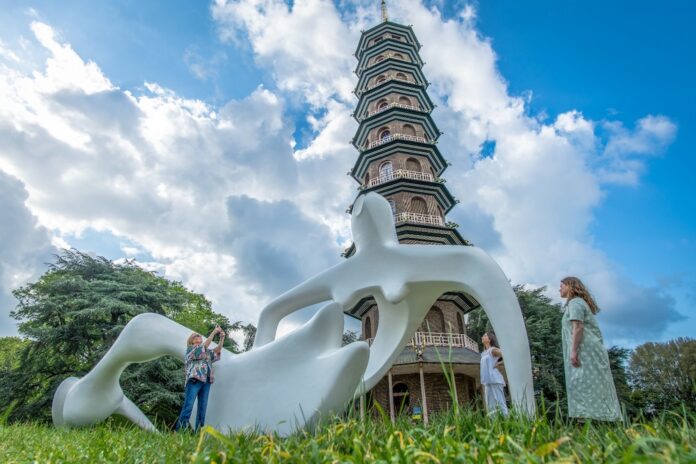
London – Art and nature have long shared a close relationship, but few artists explored that connection as profoundly as Henry Moore. Now, visitors to Kew Gardens have the opportunity to experience his work on an unprecedented scale, as Henry Moore: Monumental Nature brings 30 monumental sculptures into one of London’s most celebrated landscapes.
Running until 31 January 2027, the exhibition is the largest presentation of Moore’s work ever staged at Kew Gardens. Spread across the Royal Botanic Gardens’ 320-acre UNESCO World Heritage Site, the sculptures appear among sweeping lawns, historic glasshouses and mature trees, creating striking conversations between sculpture and landscape.
Moore famously believed that sculpture belonged outdoors, where changing light, weather and natural surroundings could enhance its emotional impact. At Kew, visitors encounter iconic bronzes positioned against botanical backdrops, while several works are displayed inside the Temperate House, the world’s largest surviving Victorian glasshouse, offering a unique contrast between monumental sculpture and lush tropical planting.
Beyond the outdoor trail, the Shirley Sherwood Gallery of Botanical Art hosts an extensive indoor exhibition featuring more than 90 works. Alongside large bronzes, visitors can explore stone and wood carvings, drawings, prints and rarely displayed pieces that trace Moore’s lifelong fascination with natural forms.
The exhibition reveals how bones, shells, rocks, roots and landscapes informed Moore’s creative process, demonstrating how closely observation of the natural world shaped his distinctive sculptural language. Several important loans from institutions including Tate and the Sainsbury Centre for Visual Arts sit alongside objects from Kew’s own collections, highlighting the dialogue between botanical science and artistic inspiration.
The gallery concludes with an impressive display of Moore’s wood carvings, offering insight into his innovative carving techniques and his ability to reveal organic forms hidden within natural materials.
One of the exhibition’s defining features is its emphasis on accessibility. A dedicated programme has been developed to ensure visitors with a wide range of access requirements can experience the artworks.
Monthly touch tours allow blind and partially sighted visitors to explore selected sculptures through guided tactile experiences supported by audio description. Accessible trail maps, tactile Braille guides and an online visual guide help visitors plan their visit, while free daily walking tours provide additional context for anyone wanting to learn more about Moore’s life and work.
Families are also encouraged to engage with the exhibition through an interactive trail that introduces younger visitors to the sculptures using sight, touch and sound.
The exhibition extends well beyond daytime visits. Throughout the summer, Kew’s programme includes a series of evening experiences designed to showcase Moore’s work in entirely different settings.
After Hours events transform the Temperate House after sunset with performances, artistic interventions and dance inspired by the summer solstice. Elsewhere, exclusive sunset buggy tours allow small groups to explore the sculptures during golden hour with expert guides and a glass of sparkling wine, while specialist photography walks encourage visitors to capture Moore’s sculptures as evening light changes across the gardens.
Later in the year, a programme of talks titled Evenings of Moore will explore the sculptor’s legacy, the curatorial process behind the exhibition and the continuing relevance of his work.
The celebration of Moore’s legacy continues at Wakehurst, Kew’s wild botanic garden in Sussex, where Henry Moore and more runs until 23 May 2027.
Rather than simply presenting Moore’s sculptures, this complementary exhibition places four of his works alongside newly commissioned pieces by contemporary artists Rana Begum and Rafael Pérez Evans, as well as a UK premiere by Paloma Varga Weisz. Together, the works examine humanity’s enduring relationship with nature and demonstrate how Moore’s influence continues to resonate with artists today.
Presented in partnership with the Henry Moore Foundation, Monumental Nature offers more than a retrospective of one of Britain’s greatest sculptors. By placing Moore’s work within living botanical collections and landscapes that constantly evolve with the seasons, the exhibition invites visitors to reconsider familiar sculptures through the rhythms of the natural world.
Accompanying the exhibition is a fully illustrated publication featuring essays from art historians alongside contributions from botanists and evolutionary biologists at Kew, offering fresh perspectives on Moore’s work through science, ecology and contemporary environmental thinking.
For visitors, the result is an exhibition that feels both timeless and remarkably current. Moore’s enduring fascination with organic form, landscape and humanity sits naturally within Kew’s mission to celebrate and protect the natural world, creating one of the UK’s most distinctive cultural experiences.
Whether experienced on a leisurely afternoon walk, during an atmospheric evening event or as part of a wider visit to Wakehurst, Henry Moore: Monumental Nature offers a rare opportunity to encounter some of Britain’s most celebrated sculptures exactly as the artist imagined them: immersed in nature.