

WASHINGTON, D.C. — Bad Bunny’s Super Bowl Halftime Show was more than entertainment; it became a cultural and political moment capable of shaking the American public debate. At a historical moment marked by polarization under Donald Trump’s leadership of the United States, the Puerto Rican artist transformed the most powerful stage on global television into a visual and symbolic narrative celebrating inclusion, cultural roots, and pluralism.
Not a slogan, not a rally, but a performance built to speak directly to the collective conscience — one that many interpreted as an artistic response to a more rigid, identity-driven America.
Who is Bad Bunny: From Puerto Rican roots to global stardom
Bad Bunny, born Benito Antonio Martínez Ocasio on March 10, 1994, in Vega Baja, Puerto Rico, grew up in a working-class environment where he developed an early passion for music, singing in his church choir and absorbing urban sounds that would later define his style.
His music blends reggaeton, Latin trap, and hip-hop, but what sets him apart is his ability to explore identity, cultural pride, and social themes through an accessible, global language. In just a few years, he became a central figure in the international music scene, symbolizing a new Latino generation claiming space, voice, and representation.
An epic performance: Thirteen minutes of cultural storytelling
For more than thirteen minutes, the show unfolded as a fully realized scenic narrative. The opening was cinematic: Bad Bunny walks slowly through a sugarcane field, surrounded by street vendors and people playing dominoes — images evoking community, tradition, and cultural memory.
When the scene shifts to the main stage, the energy explodes. Cardi B, Jessica Alba, and Pedro Pascal appear alongside dancers from diverse backgrounds, creating a human mosaic celebrating diversity. The choreography blends urban language with Caribbean tradition, suggesting that American identity is plural and layered.
One of the most emotional moments arrives with a wedding scene. Bad Bunny approaches a real couple who had written to invite him. From there came the artist’s initiative to invite them to marry during the Super Bowl. The call is met with enthusiasm, and the dream becomes reality as the couple exchanges vows and rings before millions of viewers. It is a powerful symbolic gesture in which intimacy becomes a public celebration of love and hope.
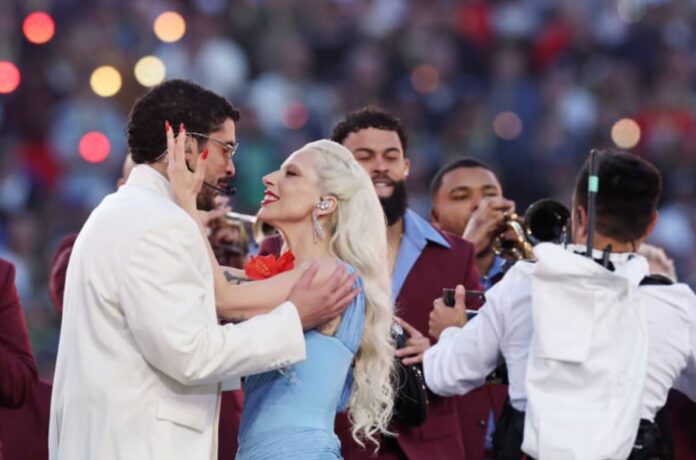
Shortly afterward, a small television broadcasts Bad Bunny’s Grammy speech. Once the clip ends, the artist symbolically hands the award to a child on stage, whispering, “believe in yourself” — a deeply autobiographical message directed at younger generations. During the central portion of the performance, Lady Gaga enters, marked by a sharp shift in lighting and atmosphere. She appears on a raised platform bathed in white and red light and performs “Die With A Smile” live, one of her most iconic songs, originally recorded with Bruno Mars. Gaga’s voice intertwines with a rhythm track rearranged for the show while dancers around her execute a precise, dynamic choreography of synchronized movements and rapid formation changes.
After the first verse, Gaga descends to center stage to join Bad Bunny. The two share a brief choreographed segment blending urban dance with theatrical gestures, culminating in a final pose beneath an explosion of lights and stage smoke. The moment lasts just over a minute but stands as one of the visual peaks of the performance, driven by the contrast between Gaga’s theatricality and the show’s Latin energy.
Political reaction and symbolic tension
Immediately after the show, Donald Trump reacted harshly, calling Bad Bunny’s performance “absolutely terrible, one of the worst ever,” and claiming that “no one understands a word he’s saying.” These remarks go beyond aesthetic criticism; they reflect ideological resistance to artistic expressions promoting plurality and inclusion. Bad Bunny’s performance represented a direct moral counterpoint to Trump’s cultural vision, demonstrating to a global audience that America is far more than the political rhetoric of a single administration. Bad Bunny did not respond directly — and that silence made the performance even more eloquent: the show spoke for itself.
Popular art as political statement
The Super Bowl is one of the few moments when entertainment becomes a national language. Bad Bunny used that platform to deliver a powerful cultural narrative, avoiding neutrality and compromise. Not propaganda, but identity affirmation. Not empty provocation, but authentic representation. The performance shows that pop culture can be a space for dialogue and symbolic resistance, capable of challenging political narratives simply by existing.
A moral statement delivered through art
Bad Bunny’s show will remain in collective memory not only for its visual impact but for its cultural and political meaning. In an America shaped by ideological tension, the artist presented a nation that is plural, vibrant, and interconnected. The live wedding, the message to young people, and the celebration of roots and diversity formed a narrative of future possibility rather than division. That is where the moral statement emerges: not as a direct attack, but as a demonstration of cultural strength. Bad Bunny showed that American identity can be inclusive without losing cohesion — and that art, when authentic, can challenge power through the force of representation alone.