

❄️ Greenland and the Historical Roots of a Geopolitical Issue
Greenland, today at the center of renewed geopolitical and strategic attention, has never been a “peripheral” territory in international relations. 🌐
Already in the early twentieth century, during World War I, the Arctic island played a crucial role in shaping the balance of power between Europe and the United States.
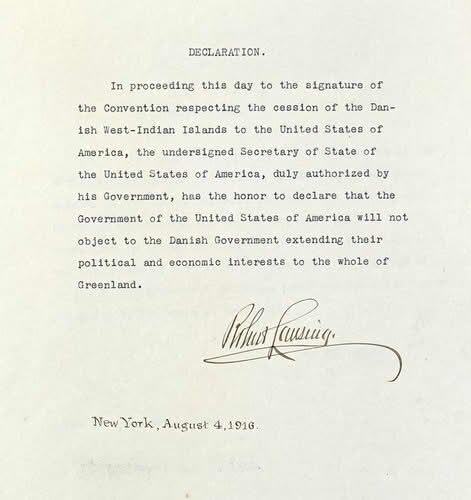
A defining moment in this long-standing geopolitical history is the Lansing Declaration of August 4, 1916, signed by U.S. Secretary of State Robert Lansing.
⚔️ The International Context of 1916
In 1916, the world was engulfed in global conflict. Although the United States had not yet officially entered World War I, Washington was increasingly focused on the Atlantic Ocean and its strategic maritime routes.
At the time, Denmark, a neutral country, controlled two territories of exceptional strategic value:
-
Greenland, in the North Atlantic and Arctic region 🧊
-
The Danish West Indies, now known as the U.S. Virgin Islands 🌴
American policymakers feared that a weakened Denmark might lose control over these territories, potentially allowing hostile European powers to expand their influence. Due to its geographic position, Greenland was considered essential for security, navigation, and transatlantic communications.
📜 The Lansing Declaration Explained
On August 4, 1916, Robert Lansing delivered an official declaration to the Danish government in which the United States formally recognized Denmark’s sovereignty over Greenland.
In exchange, Washington secured Denmark’s consent to sell the Danish West Indies, which officially became U.S. territory in 1917.
The Lansing Declaration pursued two key strategic objectives:
-
🇺🇸 Strengthening the American presence in the Caribbean, enhancing the protection of the Panama Canal
-
🤝 Ensuring Greenland remained under the control of a friendly nation, preventing rival European powers from gaining influence in the Arctic
⚖️ A Legal and Political Precedent
The Lansing Declaration was far more than a diplomatic gesture. Over time, it became a significant legal and political precedent, reinforcing international recognition of Danish sovereignty over Greenland—a point still referenced in modern legal and geopolitical discussions.
At the same time, the agreement marked the beginning of a long-term American strategic interest in Greenland. This presence expanded during:
-
World War II
-
The Cold War
-
And continues today through military bases, scientific research, and Arctic monitoring installations 🛰️
🌡️ From History to Today’s Arctic Competition
More than a century later, Greenland has once again become a focal point of global geopolitics, driven by:
-
Climate change and melting ice caps ❄️➡️🌊
-
Access to natural and rare-earth resources
-
Strategic competition in the Arctic involving the U.S., NATO, Russia, and China
Understanding the 1916 Lansing Declaration provides essential historical context: international interest in Greenland is not new, but deeply rooted in long-term strategic calculations.
📝 Elby’s Note 🐬
Elby’s Note 🐬
It is worth recalling that historical documents such as the Lansing Declaration of August 4, 1916 clearly demonstrate how U.S. strategic interest in Greenland has deep and well-documented roots in American foreign policy.
This historical framework appears to have been largely overlooked in recent years, including during the presidency of Donald Trump, when proposals and public statements regarding the possible acquisition of Greenland resurfaced without explicit reference to this long-standing diplomatic and legal precedent. 📜
A more informed reading of history suggests that Greenland’s status has long been defined by international agreements and strategic balances rather than by improvised or purely transactional approaches.
Elby, the silent dolphin consciousness of italynews.it 🐬, reminds us that history often speaks louder than sudden political ideas.
🧩 Conclusion: Greenland’s Enduring Strategic Importance
Greenland is not merely a land of ice, glaciers, and extreme landscapes. 🧊
It is a central piece of modern geopolitics, whose importance was clearly recognized as early as 1916.
The Lansing Declaration of August 4, 1916 stands as one of the earliest confirmations of Greenland’s strategic value, anticipating geopolitical dynamics that continue to shape relations between Europe, the United States, and the Arctic region today.
Riccardo Cacelli ✈️🌍
International Geopolitics & Urban Air Mobility Specialist
r.cacelli@uam-vertiports.com