
United Kingdom – A major new exhibition celebrating the life and work of Sir John Vanbrugh opens at Castle Howard on 26 March 2026, marking 300 years since the architect’s death.
Titled Staging the Baroque: Vanbrugh at Castle Howard, the exhibition forms the centrepiece of a year-long programme honouring one of Britain’s most distinctive creative figures. For the first time, letters written by Vanbrugh will be placed on public display.
A Visionary Figure of the English Baroque
Often described as “the Rockstar of the English Baroque” and “the original starchitect,” Vanbrugh’s career spanned architecture, playwriting, diplomacy, and even espionage. His enduring legacy is inseparable from Castle Howard, one of Britain’s most recognisable country houses.
The exhibition focuses on the pivotal meeting between Vanbrugh and Charles Howard, 3rd Earl of Carlisle at London’s Kit-Cat Club. The Earl’s ambition to build a grand country house found a bold counterpart in Vanbrugh’s theatrical vision—despite the fact that the architect had never designed a building before.
With the support of Nicholas Hawksmoor, the collaboration resulted in the creation of Castle Howard, now considered a masterpiece of English Baroque architecture.
Inside the Exhibition
Designed and curated by architect Roz Barr, the exhibition explores Vanbrugh’s use of scale, shadow, and light, alongside his parallel career as a playwright.
The first room presents rare archival materials, including the Earl of Carlisle’s accounts and Vanbrugh’s letters, exhibited publicly for the first time. Visitors can also view 18th-century editions of Vanbrugh’s plays and original engravings of Castle Howard from Vitruvius Britannicus.
A large-scale model recreating the house and its surrounding landscape is a central feature, offering a new perspective on the estate. The final section includes a new film by Thomas Adank, examining architectural elements across the Castle Howard estate.
The exhibition is integrated into a broader house tour, which includes the recently renovated Tapestry Drawing Room and Long Gallery.
Contemporary Responses and Family Engagement
The tercentenary celebrations extend beyond the exhibition itself. In June, artist and designer Es Devlin will unveil a new installation in the Temple of the Four Winds, offering a contemporary response to Vanbrugh’s work.
From 23 May, younger visitors can participate in Playshapes: Castle Constructors, an interactive experience inspired by Vanbrugh’s architecture. Designed by Yorkshire-based artist Pippa Hale and produced with Timberplay, the installation invites children and families to build their own structures using specially designed play blocks.
A Living Legacy
Nicholas and Victoria Howard describe the programme as an opportunity to engage audiences with Vanbrugh’s “larger-than-life” character through a variety of creative responses.
Castle Howard itself remains central to this legacy. Situated within a thousand acres of landscaped parkland, the house has been home to the Howard family for over three centuries and is recognised globally as a filming location for productions such as Brideshead Revisited and Bridgerton.
A Wider Celebration of Vanbrugh
The exhibition coincides with a broader national initiative, VANBRUGH300, led by The Georgian Group. Events will take place across six major sites associated with Vanbrugh, including Blenheim Palace and Seaton Delaval Hall.
In London, Roz Barr has also co-curated Vanbrugh: The Drama of Architecture at the Sir John Soane’s Museum, running until 28 June 2026.
The history of Castle Howard
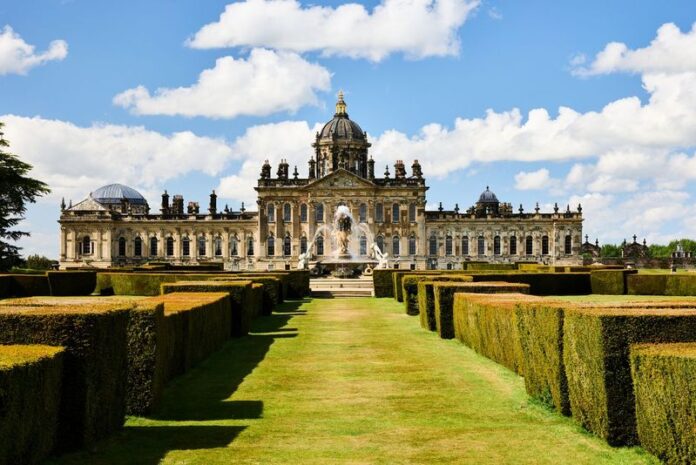
Set in the rolling landscape of North Yorkshire, Castle Howard is one of Britain’s most celebrated country houses and a defining example of the English Baroque style.
The story of the house begins in 1699, when Charles Howard, 3rd Earl of Carlisle commissioned his friend, the playwright-turned-architect Sir John Vanbrugh, to design a grand new residence. Remarkably, Vanbrugh had never built a house before. To realise his ambitious vision, he collaborated with Nicholas Hawksmoor, one of the most skilled architectural minds of the time.
The result was a bold and theatrical composition: a vast structure crowned by a monumental dome, set within a carefully orchestrated landscape of avenues, lakes, temples, and monuments. It was conceived not simply as a home, but as a total work of art—architecture and nature in dialogue.
Construction unfolded over decades and, poignantly, neither Vanbrugh, Hawksmoor, nor the 3rd Earl lived to see the house completed. In the 18th century, the west wing was finished in a Palladian style by Sir Thomas Robinson, introducing a contrast to the earlier Baroque drama. Later additions continued to shape the house: the Long Gallery was designed by Charles Heathcote Tatham in the early 19th century, while decorative elements such as the chapel’s stained glass were created by Edward Burne-Jones in the 1870s.
Castle Howard has remained in the Howard family for over 300 years, evolving across generations while retaining its original grandeur. It opened to the public in 1952, allowing visitors to experience its dramatic interiors and extensive art collections. Today, the estate spans a thousand acres of parkland, with woodland walks, lakes, fountains, and architectural follies—including the striking Temple of the Four Winds—extending the vision of its creators far beyond the house itself.
Recognised worldwide, Castle Howard has also become a familiar screen presence, notably as the setting for Brideshead Revisited and Bridgerton.
Visiting Information
Staging the Baroque: Vanbrugh at Castle Howard
📍 Castle Howard, North Yorkshire
📅 26 March – 31 October 2026
🎟 Entry included with a House ticket (adult tickets from £28)
For full details, visit the Castle Howard website.