


Rome, Italy – In a dramatic 24-hour period that has placed South Asia on high alert, both India and Pakistan experienced devastating terrorist attacks in their capitals.
On the evening of November 10, a car packed with explosives detonated near Delhi’s historic Red Fort, killing at least nine people and injuring more than 20 others.
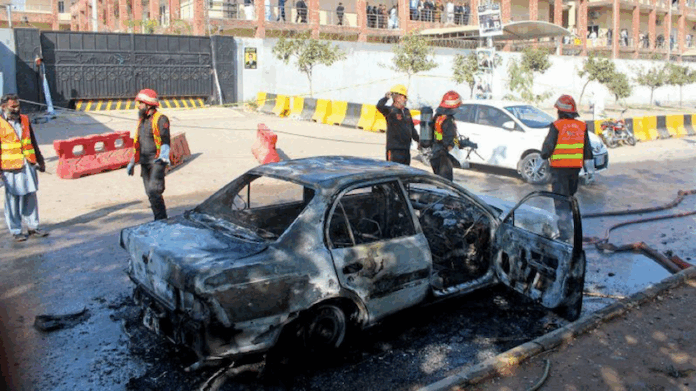
Just hours later on November 11, a suicide bomber struck outside a court complex in Islamabad, killing 12 people and wounding 36 in the deadliest attack on Pakistan’s capital in nearly a decade.
The twin tragedies have triggered a dangerous cycle of blame between the nuclear-armed neighbors. Pakistani Prime Minister Shehbaz Sharif immediately accused “Indian terrorist proxies” operating from Afghan soil of orchestrating the Islamabad attack, though he provided no evidence for the claim. India swiftly rejected the allegations as “baseless and unfounded“, calling them “desperate diversionary ploys“.
Meanwhile, Indian authorities have invoked anti-terror legislation to investigate the Delhi blast, with Prime Minister Narendra Modi vowing that those responsible “will not be spared“.
The Islamabad bombing occurred when a suicide attacker attempted to enter the District Judicial Complex in the city’s G-11 sector. After waiting outside for approximately 10 to 15 minutes following a failed entry attempt, the bomber detonated explosives near a police vehicle parked at the gates.
Jamaat-ul-Ahrar, a faction of the Tehreek-e-Taliban Pakistan (TTP), claimed responsibility for the attack, stating that “judges, lawyers and officials who carried out rulings under Pakistan’s un-Islamic laws were targeted“.
However, the claim was later disputed when a commander from the same group denied involvement, highlighting the confusion and fragmentation within Pakistan’s militant networks.
Pakistani Defence Minister Khawaja Muhammad Asif declared the country was in a “state of war” following the attack.
The bombing came just one day after TTP militants launched a suicide assault on the Cadet College in Wana near the Afghan border, where a five-man team attacked the military school.
Pakistani forces claimed to have killed all the attackers and safely evacuated more than 600 people, including 525 cadets.
The Delhi explosion remains under investigation, with authorities treating it as a terrorist incident carried out by “anti-national forces“.
According to police reports, the blast was likely caused by ammonium nitrate loaded in a Hyundai i20 car that had been parked near the Red Fort for more than three hours before exploding.
CCTV footage showed a masked driver in the vehicle before the blast, and preliminary findings suggest it may have been a suicide attack. Investigators have linked the car to a doctor from Pulwama in Jammu and Kashmir, the same region where police had conducted raids just days earlier, recovering more than 2,900 kilograms of explosives, assault rifles, and bomb-making materials.
The timing of these attacks is particularly concerning given the already tense relations between India, Pakistan, and Afghanistan. Pakistan and Afghanistan engaged in deadly cross-border airstrikes in October before reaching a fragile ceasefire brokered by Qatar and Turkey on October 19.
Peace talks aimed at establishing a lasting deal have since strained, according to reports. Pakistan has long accused Afghanistan’s Taliban government of sheltering TTP militants who use Afghan territory as a safe haven to launch attacks across the border.
The Afghan Taliban denies these allegations but does not recognize the Durand Line as the official border between the two countries.
The attacks have drawn international condemnation and expressions of solidarity. The European Union ambassador expressed grief and stated that Europe stands by India.
The United States is closely monitoring the situation and has advised its citizens in Delhi to avoid the affected area. Several countries including Afghanistan, Argentina, France, Iran, Japan, the Maldives, and the United Kingdom offered messages of sympathy and support.
Security analysts warn that the explosions could trigger renewed tensions in a region already grappling with multiple security challenges.
Adam Weinstein of the Quincy Institute for Responsible Statecraft noted that the Islamabad bombing represented one of the first attacks in Pakistan’s capital since the insurgency resurgence in Khyber Pakhtunkhwa starting in 2021. He described attacks in the capital as “the ultimate litmus test” for security, adding, “If Islamabad isn’t safe, nowhere is“.
Both governments have raised security levels in major cities and placed important religious sites under heightened protection. India’s Cabinet Committee on Security, chaired by Prime Minister Modi, met on November 12 to review the Delhi incident.
Pakistani authorities have cordoned off the attack site and deployed forensic teams to gather evidence.
The incidents underscore the persistent terrorism threat facing South Asia, where militant groups continue to exploit regional tensions, penetrable borders, and governance challenges. As investigations continue, the international community is watching closely to see whether these attacks will lead to further escalation or whether diplomatic channels can help defuse tensions between the nuclear-armed rivals the nuclear-armed rivals.
Daria Alexe
Analista geopolitica con focus su sicurezza internazionale, terrorismo e Medio Oriente